Friday, 1 March 2013

Day One Rehearsal: Story Circle, Costumes and Truth Stick: Blog 50

Morning All.

What a lovely day I had with actors rehearsing Mullered  yesterday! 

Its such a great thing to be back in the studio with a team who are already 'performing'. So Natalie, Jordan, Karl, John and I get to play together again. I am not sure I have  said it before but I have to admit to being a bit of a serial lover! Its being in that light delightful space that does it. And well, these guys in particular too - I refer you to my earlier blog about 'Luvvies', Love, Murdering Your Darlings and Generosity, Blog 21. Enough said.

So the first part of the rehearsal was the gathering, bringing all the props and set into the space and placing and setting them and then the costume parade. That's fun thanks to the main character being Thomas Briggs, the first person to be killed on the railway in 1864, and Franz Muller, his murderer. 

Great Victorian formal wear for both characters of course. Every gentleman was expected to wear a coat, vest, and hat. To walk around in shirtsleeves without vest or coat would be the modern-day equivalent of traipsing about in one’s underwear. Very unseemly, and most ungentlemanly! So a vest, coat and hat are essential with a visible accessory or two, in our case a pocket watch for Thomas. 

The other characters are set in 2013 so costume is pretty much everyday young people's uniform - not that I would wish to stereotype of course! 

Set positioned, music set up, costume parade ticked off and script revisited for memory, we began the orientation work. As this is a group who have worked closely before, there is already an established common language, in fact Jordan and Natalie have worked together for over five years now, and 
Karl is back for about the sixth time, and John for his second time, (why does this sound like a prison sentence?!). So we can immediately cut to the chase, as we don't need to do the 'forming' stage. However we do need to acknowledge that we have been off living other lives since we were last in the space together. And one way to do this is to begin with a story circle.

Yesterday I was also accompanied by my trusty old Truth Stick, which serves as a story telling stick too. Natalie was surprised to see my old friend and tells me I haven't brought it to rehearsals for a few years now! My stick (this image isn't my actual one) is a brightly coloured snake. 

So the story circle begins with an opening question to Jordan. The answer must take no more than 2 minutes.  (Its important to add here that this is not a therapy session and actors are invited to only share that which they are ok with sharing!) 

'Tell us about a moment or experience of anger you have had over the past few weeks' - and so the story begins, with Jordan holding the story stick. And so we go round the circle, stories about moments of curiosity, conscience, loss, indecision and more. And we listen, sometimes painfully and sometimes erupting into hysterics. The exercise takes an hour and then we break for lunch, and we are ready to hit into text when we get back.

The afternoon is worker like, returning to the script which is one of Olly's that I like a great deal. Step by step we revisit every moment, scrutinising it from every angle and refinding and revitalising it. There's great new stuff surfacing, and as John said with the benefit of a few months gap between productions, there is a wealth of new ideas and hunches about character and dynamics.

Good day all round, we sketched through the first 15 pages of the 50 page script, so today we should get a wiggle on and get through to the end. 

My day was rounded off perfectly with dinner with my good friend Simon Grennan, one of the powerhouse artistic team of Grennan and Spearandio (if you are interested see my Blog 8A for more about their Truce project on which we collaborated last year). We went to Julies in Holland Park on the recommendation of Theresa our Communications Manager. Thanks for the suggestion T - it was fabulous  - I highly recommend it! And thanks to Simon for footing the not insubstantial bill! 


Have a lovely day.


Thursday, 28 February 2013

Guest Blog from Amari Blaize in response to my NHS blog:

Amari Blaize
Thanks to Amari for this Guest Blog today - written in response to my blog Theatre while you work at The NHS: Blog 48

I love the NHS. I think we Brits are very fortunate to live in a society that provides a health service free at the point of delivery. It must be protected at all costs. AND THERE IS A HUGE ‘BUT’.

Just as governments pander to the rich and powerful lobbies – food, tobacco, drink, arms, so the health service panders to the pharmaceutical companies. I have no wish to take a political stance, although it is about politics…the politics of health. Having had to confront a critical illness over the last five years, I have first hand experience of a health service whose whole raison d’etre is the ‘management of symptoms’ through allopathic drugs, and know little to nothing about healing. And certainly have no consideration for the ‘wholeness’ of the person.

And having participated in the past with the kind of formulaic approach to forum theatre that does that ‘wash and go’ thing, I do hope the NHS has the good sense to commission ARC Theatre for Change to do a piece on, in that doctor’s words: “culture shift…that promotes putting patients at the heart of the decisions that doctors make about patient’s healthcare…’No Decision About Me Without Me’.”

An indication of their good intention would be to ensure that an Arc piece runs the length and breadth of the British Isles, engage a cross section of those who ‘care for patients’ from the cleaners and caters to the nurses and consultants. And there is real monitoring of progress and a follow up in a year, then five years, and constantly taking the temperature through patient feedback over time. But that aint gonna happen is it? We can only do the best we can with what we get.

So here is a challenge for you Madam Director: How to weave a Web of Transformation (back to Cinders) in a fossilised structure or Matrix of collective thought that is the NHS!

The Webs We Weave: The Actor's Matrix: Blog 49

Good morning.

So for the last few days I have been in gathering mode, building possibilities for new projects - in a cerebral space really. (well not too cerebral actually!)

But today I am in rehearsal with Mullered by Clifford Oliver and I am really excited. Going into the rehearsal/imaginal space is warm and familiar, but also stark and sharp. It embodies the imagination, and as such can offer up many goodies, but it also the empty space. Its a playground and a factory.

Today though I am not starting from scratch as I have made this piece already - it just hasn't been out for a few months. Today is about revitalising and igniting the material. Finding it freshly. 

And the other great thing about today too is that I don't have to worry about budgets, persuasive outcomes or targets. Hurrah! (Don't get me wrong - I do LOVE targets!). Yesterday's blog was all about that really - in fact my friend Amari told me it was a bit boring, which made me laugh, because sometimes that searching for a connection/narrative bit of my job can be like looking for a needle in a haystack and it takes a while to spot it. Its technical.

But today its about four actors in the imaginal space and me. As you will know if you regularly pop in on my blog, I have been writing a bit about emotional access recently and the steps to releasing character. So in anticipation of today's rehearsal and the reorientation of the actors into character, I am thinking about webs and matrixes.

Webs and matrixes are beautiful and complex structures - the dictionary definitions say:

Web: 

Noun
A network of fine threads constructed by a spider from fluid secreted by its spinnerets, used to catch its prey.
Verb
Move or hang so as to form a weblike shape: "an intricate transportation network webs from coast to coast".


Matrix
Noun
An environment or material in which something develops.
A mass of fine-grained rock in which gems, crystals, or fossils are embedded.


And that pretty much sums up the job. I will spend time today with the actors revisiting and building the character's web of relationships within the matrix of the play. This is always a great process as it produces fertile networks and connections.


We all live in webs, indeed the invention of the world wide web is merely a mirror image of this probably  - its an exquisite architecture. 

If you think about your own life and the web of family, friends, work colleagues etc imagine just how many relationships you live in and with? You manage this physical and  emotional landscape on a daily basis and you are different in each of them. At any one time we might be engaged in several hundred complex emotional relationships and we have to adjust to each as we need to. Depending on who we are with, talking to, the intimacy or formality of the relationship will determine the energy we use, the tone of voice, the physical proximity. Its a dance.

Its pretty easy to manage that one on one (is it?) - but faced with a room full it can be daunting. Is it any surprise that the bride and groom fall exhausted into their marriage bed after a wedding day full of "managing" relationships.  Its no surprise that these hot house occasions are wonderful settings for life's biggest intimate dramas!

Making these rapid emotional shifts is what we do. 

Have you ever had that experience when you are in the middle of a heated  argument with a family member and the door bell rings and you have an unexpected visitor? You invite them in for coffee and both you and your family member have to perform emotional gymnastics to change the mood in the room and cover up the previous antagonistic energy! Its life isn't it?


So to the actor. In creating character I work with the web. I ask the actor to place themselves (their character) at the centre of an imaginary web. This is done physically, so the symbolic web is set in space in the studio. The actor employs visual and emotional imagination to 'people' the web with all those others he conjurs to life for his character. The web is as big as the actor wants to make it. The people closer to the centre are those very 'present' in the character's life at the moment in which the play is set. This does not mean close in an easy trusting way necessarily, or even alive at the time of the setting. Sometimes a person in the life of the character might be huge and very close, but extremely intimidating or dark and dominating.

Working with 'summoning' these relationships into the space does a number of rich things. It deepens the emotional work needed by the actor, references the narrative arc fully, but perhaps most importantly embodies the inherent emotional and rational contradictions and incongruities in the character's life. 
This is where lazy character work can let the actor down. It can be too neat, too systematic and linear. People are not like that - we are full of contradictions. 

And so in creating character the actor must learn to imagine and tolerate things that don't fit nicely together. For example if you had to play Hitler, how would you approach him? You couldn't just play evil. In fact you would have to work hard to create love from Hitler's perspective.

So it is with character as with the people that we base them on - the same person can be loved and admired by one person in their lives, and hated and reviled by another. But of course they are still themselves whichever "face" they choose to reveal at any time, or on which others project.

This work on relational webs in creating character is very useful - and a tool I use unfailingly. You can do it in lots of ways and its useful for the actors to capture it in a drawing that they can take away with them for their character portfolio at the end of the rehearsal day. 

So excitedly off to the studio- catch you tomorrow.


Wednesday, 27 February 2013

Theatre while you work at The NHS: Blog 48


Good morning!

Well no one can say the life of a theatre director is boring! I am constantly amazed at where I find myself. And I am always curious and excited about how theatre squeezes itself into nooks and crannies in the most unusual of places. Our work has taken us from performances on busses, in living rooms to Waterloo Station concourse! 

Its also fascinating to meet the people who "get" that bringing a performance into a non-theatre space can vitalise and animate it and transform thinking. It was one such person who invited me yesterday to spend the day at a NHS Clinical Commissioning Group conference half way up the M1. 

I had not a clue what a CCG is. I have to admit to a real dislike of acronyms, they seem to me to rip the heart out of language, but I do appreciate that they probably can't be avoided. But I approached my adventure with my usual curiosity. I will be meeting people after all!

I found myself in a group of about 80 medical health professionals mostly GPS but also some consultants and managers. They had come together to talk about their new role as commissioners for health services as the NHS goes through its biggest reform since it began. So what on earth brings me to this drug company in a business park and what part can Theatre possibly play here?

I was invited at this early stage of our potential contract to observe the group working on making sense of how they will commission services. I have heard of course about GP's taking over the reins of health commissioning, but not given it much thought to be honest. It took me a little bit of time to understand exactly what the question is, but its always great to hear specialists discussing their subject and it doesn't take too long to get a sense of what exercises them. It is of course the core of their narrative.

I learnt that commissioning in the NHS means the procuring or buying of services following the disbanding of Primary Care Trusts (PCTs) which have traditionally commissioned services from local hospitals for the local population, whether that be an operation, an outpatient appointment or a trip to the podiatrist.

The NHS reform bill has essentially put these commissioning decisions into the hands of GPs, clinicians who understand what is needed in the best interests of patients. GPs care for families from cradle to grave. They understand their physical, psychological and social needs so are in a uniquely privileged position to see what works and what doesn't work for them. Many GPs have seen systems come and systems go - fundholding, PCGs, PCTs. The NHS bill has now given them the opportunity to be at the very heart of deciding how, when and where their patients receive their treatment and from whom. 

PCTs are being replaced by Clinical Commissioning Groups (CCGs).
The main thing one of the GP's said to me is that the culture shift that the bill promotes is about putting patients at the heart of the decisions that doctors make about patient's healthcare..."No Decision About Me Without Me".

The key thrust of the new commissioning is that the CCG's will use what patients tell them to influence commissioning decisions as GPs. 


Mmmm it all sounds ok........ but it does raise a little niggling voice for me. I do believe the GPS I spoke to yesterday have the very best of intentions to listen to their patients and make their buying decisions based on these conversations. After all don't they do that every day? 

I also know that often in reality 'consultation' is a code word for presenting and getting buy in to an already fully made plan. A way of implementing something without too much opposition. So we will see.

So how do we fit in here? Well we will be commissioned to make a piece of interactive theatre to explore the conversations that GPs will have with their patients to find out what works for them and their needs. We will make a series of narratives with characters, conflicts and perform them to provoke and open up underlying themes and issues. 

A key concern is that in consultation groups you tend to get the same people which can skew the information. Its easy then to go with the majority - and miss out on the core and underlying issues for different people and communities. So our job will be to use theatre to raise real emotions and questions and explore them with the audience of doctors. We will turn a meeting room into a theatre, and do what we do, tell a powerful and emotionally engaging story that moves people and gets them thinking.

Mullered by Clifford Oliver, Carl, Natalie, John and Jordan
All in a day's work! 


Tuesday, 26 February 2013

No Means No: Finding The Words Girls Receive Borough Commendations: Blog 47


Good morning!


Chief Superindendent Andy Ewing presenting Commendation to Ebun
As promised some photos from last night's Special Police Commendation Awards at our home at the Malthouse Studios in Barking. 

It was a great evening and the girls from Finding The Words Programme rose to the occasion as always of course. Everyone dressed up beautifully to present their film to an audience of head teachers, teachers, councillors, parents and friends and of course to the Borough Commander Andy Ewing who was behind the whole event. 

We do things simply at Arc, but we love to welcome people to our home. Nita and Natalie went to Tescos and bought some lovely nibbles kindly funded by Andy's team. Natalie and the girls have a thing about cake on the FTW programme, so we always have some yummy goodies! And yesterday was no exception! 

The evening opened with Natalie and Grace (Film maker) sharing the vision and ambitions of the programme. They then passed over to the girls, who took it in turn to share their experiences of the programme. It made me tingle to hear them speak with such power and confidence, especially those young women who had started the project as shy and quiet girls. Their passion to speak up as and for young women reminds me of thirty years ago when I was heavily involved in the Women's movement. This is a new way of doing things. 

I was particularly struck by how much impact their presentation to the boys only audience at Warren school had on the girls and I was so impressed by how clearly they spoke about the opportunity to speak to boys about their experiences. I was fortunate enough to have attended the Warren presentation, and I saw how enormous it was for our young women to stand up and talk directly to boys of their own age and older about how it is to be treated badly by boys, and how they won't stand for it. 

Natalie told the audience how BBM went wild after that performance with the message "No means no" passing from student to student. This memorable phrase is one which is repeated in the excellent poem that four of our girls performed last night.


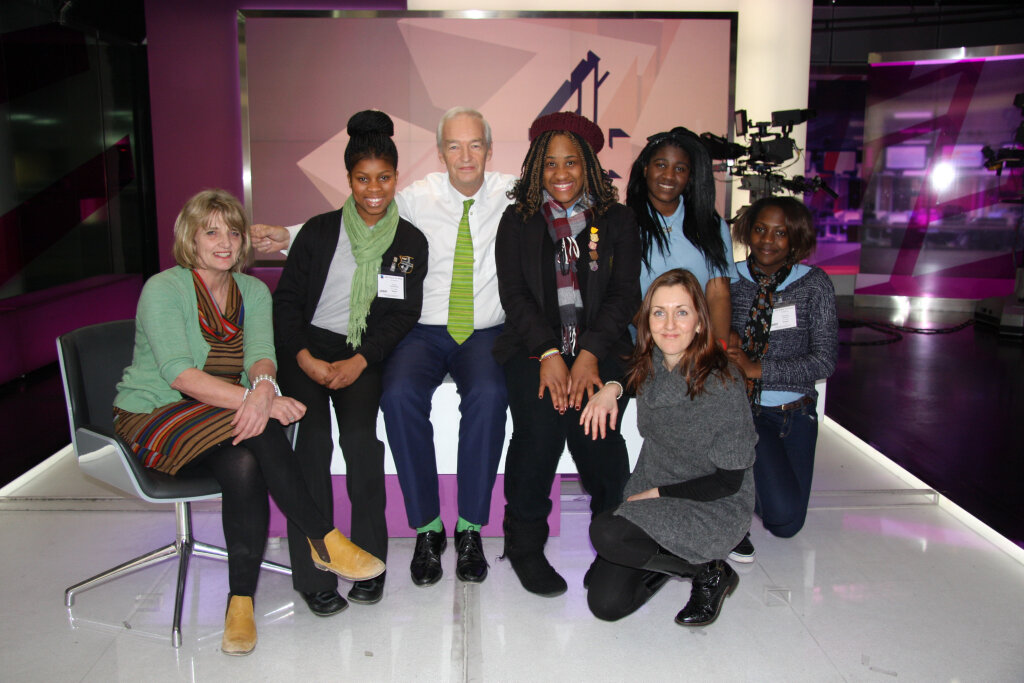
Ebun spoke about her visit with Sarah, Precious and Sefumni to see our new Patron Jon Snow at Channel 4, and how they sat in the control box to see Jon's news programme live. This has made a big impact on them! After the girls addressed the audience, they presented their film. There was silence in the room and when the film finished the audience erupted with warm applause.

At this point in the evening, Chief Superindendent Andy Ewing spoke to us. It was wonderful to hear our local senior police officer speak with such passion and enthusiasm about the girls' work. Andy said he had been very moved by the film and the girl's work and that he feels that girls have the key to unlocking some of the core issues around teenage domestic violence. Andy said that the presentation of these commendations to the girls is a departure for him, as they are usually reserved for police staff and local individuals who serve the community. 


Andy presented each of the girls with their framed commendations, speaking a citation to each which Natalie had written to honour each person's contribution.


The evening ended with further discussion, more photos and lots of cake!

A very big thank you to Andy for having this lovely idea and for honouring our wonderful young women, who will be moving forward as leaders, role models and mentors for young women in our community.

What a special evening it was - I am totally in awe of our fabulous girls - leaders of the future! 

Some Iphone photos of a few of the presentations.


Andy Speaks to the FTW young women
Andy Presents Commendation to Sefunmi


Katherine


Phoebe
Andy with the Commendation Certificate
Cherry Kandi


Sylvia


Monday, 25 February 2013

Andy Ewing Borough Commander Guest Blog: FTW Girls to receive Borough Commendations: Blog 46


A very good morning.


Chief Superindendent Andy Ewing
I am delighted to welcome Chief Superintendent Andy Ewing as my Guest Blogger this morning. 

Today promises to be a very exciting one! This evening we will welcome parents, teachers, headteachers, councillors and friends to the Special Commendation Presentation evening which is to be hosted Andy who is the Borough Commander for Barking and Dagenham at our Studios at the Malthouse.

Andy has been hugely supportive of our Finding the Words Programme led by Natalie and Neelofer with Grace as film animateur and maker. The girls have been working together over the past year and have made a film which includes their own poetry and drama. They take the film to schools and youth clubs and share it with their peers and lead discussions on the themes of teenage domestic violence and the dangers of getting involved in gangs. We are so proud of them all and delighted that Andy is choosing to honour their work with these Borough Commendations! 

Thanks to the generous funding of the Paul Hamlyn Foundation we have been able to make this work exclusively for our home borough. Its wonderful to be work in such close partnership with Andy and his team and all our friends in Barking and Dagenham.

I am delighted that Andy has written a guest blog for today about the programme

Andy's Guest Blog:
Our Girls! The Finding The Words Programme (Photos:Theresa Snooks)

I first watched the Finding the Words film some weeks ago now but I have not forgotten the initial impression it made upon me. 

The sheer application, team work and dedication apparent in the making of the film, let alone that given to the delivery and wider dissemination through the performances is very remarkable. 

What stands out for me is the profound impression that the work will have had on the cast and how it will demonstrate to them just what they can achieve both individually and collectively should they chose to. Any work which encourages young people to be able make and take choices which take them forward in life must be a good thing. I really hope that in time the girls will take forward the undoubted confidence gained from the project and influence others;particularly young men, to show that choices do exist and that violence in particular takes none of us anywhere. 
Our Girls: FTW Programme (Photo Theresa Snooks)

I am very much looking forward to making Borough Commander Commendation awards to all of the girls on Monday 25th of February and would like to take this opportunity to congratulate Natalie and the team at Arc for such inspired work. 


Thanks to Andy for this. I can't wait for this evening and will update you with news of the event tomorrow. Have a good start to your week! 
Ebun, Sarah, Sefunmi Precious at C4 with our new Patron Jon SnowGirls:  
The Finding The Words Team: JOLENE HAYFORD,EBUNOLUWA ORE,KATHERINE PIRIE,ARIANA SOFIA LOMBA,ADELE STAR ADEYEMI,PHOEBE STEPHENS,LEONITA LAURENT,SYLVIA ZARANEK,HAZVINEI KAMHONO,NATASHA MTETWA,JENNIFER EZEBUENYI,CHERRY-KANDI HAZLEWOOD-TENNANT,ELIANE LOPES,SEFUNMI OLATUNJI,PRECIOUS AYEBOLA,THANDIWE BANDA


Sunday, 24 February 2013

The Training Of Triple Action Theatre and Mike Alfreds: Blog 45


Good morning.


Following my recent posts on my time working with Triple Action Theatre in Poland I was contacted yesterday by the very actor I described in my first Frozen Poland blog. I have had very little contact with Maciej over the years but he had seen the blog and we plan to Skype tonight to catch up. He contacted me to pick up on our story and to remind me too of the things we did in 1981 as part of the Kalambur Festival. 

Coincidentally I also got a message from Phelim McDermott, (Director) who I spent some time with in the eighties when he was making his solo piece 'The Cupboard Man' with Julia Bardlsey (based on Ian McEwan's book) which went on to great success at the Edinburgh Festival. He sent me the image above which is a paper about the training of Triple Action Theatre, produced by Peter Hulton through his Dartington Series of Theatre Papers. Funnily enough when sifting through things recently in the loft I found my own copy. It is in the fourth series and is available digitally at 


http://spa.exeter.ac.uk/drama/research/exeterdigitalarchives/media_listcatalogue.php?type=102. 

There are five series dating from 1977-1986 and these are seminal works in theatre practice and a great resource for students. Peter continues to make films about practice driven by his particular curiosity about theatre making, and his forensic eye for detail and authenticity.

Much of the influence on my own work with actors has its core in this early work in the eighties with Triple Action. It was typical of the physical theatre work of the time, such as that of director Mike Alfreds with his influential touring company Shared Experience. There was a desire to break through the comfortable relationship of performer and audience and to invite a genuine co-creation between them. Mike Alfred's work was and still is seminal and had a huge impact on me when I first saw it at the  St Luke's Theatre in Exeter when I was a student. 

In the Seventies, Alfreds did away with elaborate sets, costumes and lighting to return the focus to the actor, embodying the philosophy in Shared Experience, performing his own adaptations of literary classics on the scale of The Arabian Nights, Bleak House and A Handful Of Dust. His equally acclaimed Chekhov productions led to an associate directorship at the National Theatre in the mid-Eighties, climaxing in a multi-award-winning Cherry Orchard with Sheila Hancock, who described him as "the perfect director to coax a performance out of me".

In the digital age Alfreds is passionate about the essential "live" quality of theatre. He points to the exciting things that happen in rehearsal that almost never happen in performance. "Those electric moments where an actor opens up and discovers something amazing or where two actors suddenly take off in a scene. That is usually contained and neatly reproduced and the impact is lost. The truthfulness, the immediacy and vivacity, the spontaneity, the daring and vulnerability, all the things that actors have, must be worked on to give them freedom.

"I have auditioned hundreds of actors and again and again they tell me that although they've been busy, they've had no useful experience. They haven't been pushed or changed. It's because there's no real process and I don't believe you can give anything to an audience unless you go through something. You can give them tricks or externals like timing or charm or your standard repertoire, but to give audiences something real the actor must stretch him or herself." (Independent 1996)

To achieve this, he and his actors create a complete infrastructure and framework, breaking texts down into simple actions and then connecting the actors back to it once they have made all sorts of discoveries about character and motivation. "They do an awful lot of work on the environment and space, their relationships, style and what the play's actually about, hopefully embodied in a very organic way through the very long and elaborate rehearsal process. Then, whatever they choose to play will be right, because it's true to that particular moment. They have to give up getting, say, a laugh on a specific line. You must be absolutely in the moment, playing whatever the moment demands."

If that sounds like all talk and no action, Alfreds refutes the charge. "I make them forge the work on the floor. They have to discover by doing. Get them free with the text so they never do it the same way twice."

Director - Mike Alfreds

Triple Action was another such training stable, although the work was darker and touched on murkier themes, obsessed as director Steve Rumbelow was with the unleashing of the power of shamanism. Essentially though, both directors placed the actor's creativity at the centre of their process, by cultivating a "creative field" in which to explore essential human myths and themes. This encouraged a whole group of young performers (including me!) to see themselves as architects and authors of emotion and physicality. 

These were heady times, and whilst I would never want to be back in the same context now as things have moved so far away from those Thatcher year preoccupations, much of the methodology has become part of my DNA, and I use it unconsciously and consciously on a daily basis and share it with and teach it to the actors and students I work with. 


Have a good Sunday.